
God for Rationalists
Psyopsing Yourself into a Better Life

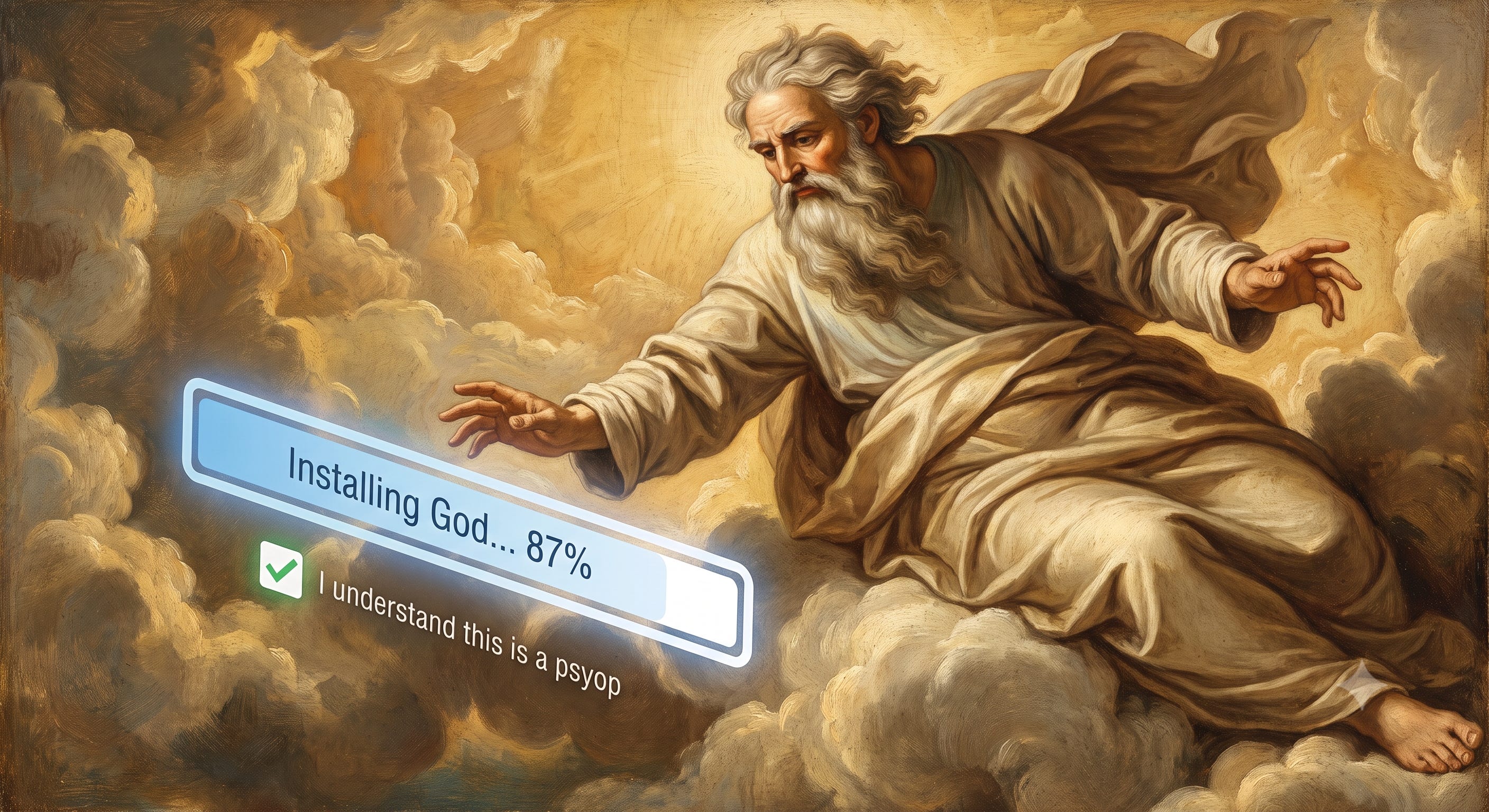
I recently saw somebody online say that "there is a place in one's life for an all-loving, all-forgiving God." I found this framing interesting. They weren't making a claim about whether God is real — they were describing a useful tool, almost like they were describing that there's a place in one's life for comfortable shoes, or owning a hammer.
I want to provide this tool to you, this piece of technology, so that you can have access to it as well. I want you to psyop yourself into "believing" in "God." And I want to do it in a way that requires exactly zero faith. That sounds like a contradiction, but it isn't, and the rest of this article is showing you why.
You already believe the small versions
You already accept the small versions of this idea. You accept the placebo effect. You may have even heard of open-label placebo studies, where the placebo works even when the patient is told it's a placebo. The literature on this is still young, but the direction is consistent: telling people it's a sugar pill doesn't necessarily stop the sugar pill from working. You can know it's a psyop, run the psyop anyway, and still get the benefits.
You probably also accept that believing in yourself improves your performance. "Believe in yourself" is a psyop we run on ourselves all the time, and it works well enough that we teach it to kids and athletes without any embarrassment. Nobody thinks the belief has to be cosmically true for it to work. So you already believe that the beliefs installed in your head change your outcomes, and you already believe that knowing about the install doesn't break it. Everything else in this article is just taking that idea and scaling it up.
Let God be naked
You don't have to convince yourself that God is real. You can let God be completely naked. You can tell yourself "I'm psyopsing myself, and it's good for me," and then do it anyway. No faith required, no pretending to believe something you don't. You simply use the tool with full knowledge that it's a tool, the same way you'd take the open-label placebo.
In fact, it's easier to believe in a naked God, because there's nothing to defend. When someone tells you "but God isn't real," you can just agree with them, and nothing happens to the tool. It keeps working.
And if part of you is squirming right now — wait, aren't I believing something because it's useful instead of because it's true? — notice that you're never actually claiming God exists. You're not holding a belief at all. You're installing an attitude, the same way an athlete installs confidence before a game. An attitude can't be false. That's exactly why the naked version works.
The God you're already running
You might be thinking: I'm an atheist, I don't have a God to patch. But you already have a God installed in your head. You just never chose it.
Consider what you actually believe about forgiveness. There are things you don't forgive yourself for, things that feel too heinous or too permanent. There are conditions on when you're allowed to love yourself: performance conditions, achievement conditions. Somewhere in your head there is a ledger, and something is keeping that ledger, and whatever that something is, it is not all-loving, and it is definitely not all-forgiving.
That's a God, and it has specs. It was installed by your parents, your culture, evolution, and nobody in particular, and its specs are terrible. Forgiveness is rationed, some things are marked unforgivable, and love is conditional on performance. Deleting the word "God" from your vocabulary didn't uninstall any of this programming. It just removed the icon.
And rationality can't save you from this, because rationality can tell you how to get what you want, but it can't tell you what to want, or whether you deserve forgiveness. Those are starting assumptions you choose, not conclusions you derive. Which means you are already running unchosen assumptions about whether you deserve forgiveness and love. The only question is whether you get to choose them. So the ask here isn't to install a belief where none exists. You're already running a god with awful specs, and I'm offering the same software with the limits removed.
A patch that removes the faith dependency
I think of religion as a technology, a spiritual technology. The human head is the most complex structure we know of, and religion is humanity's longest running engineering project on it: how do we write the beliefs we actually want into our own minds? Every tradition is a design attempt at this problem, and like all long running engineering projects, it has made real progress, and it has carried legacy code.
The biggest piece of legacy code is the faith dependency. Traditional religion requires you to believe first, and belief is hard. Jesus kept saying "O ye of little faith," and my honest response is: yep, correct. That's us. We have little faith. What do you want to do about it? Faith is hard, and as a system requirement it doesn't even make sense, because a God that requires faith fails you exactly when you need it most. The moment your faith collapses, the whole thing goes down with it. In engineering terms, it's a single point of failure.
What I'm describing here is a patch, one that removes the faith dependency entirely. When my belief collapses, and it does, I fall back to "well, it's just a useful tool," which was the ground floor the whole time. You cannot lose faith in a tool you never had faith in. It's a fault-tolerant "God."
Honestly, faith-based religion always looked to me like the white-knuckling grindset version of religion: straining to hold a belief, and feeling guilty when you can't. What I'm offering here is the relaxed version. The easy way out. Don't actually believe in God. Just use "God" without believing in him.
Gathering the requirements
If we're choosing our own axioms, if we're engineering the install ourselves, then why these specific qualities? Why all-loving, all-forgiving, all-merciful? Because those are the qualities we all want the universe to have. We're simply reverse-engineering the spec from what feels good to have installed in a human head. We all want our DoorDash to come faster, and we all want to be forgiven for the things we've done. Nobody wants their forgiveness slow and their love conditional.
Except that's exactly what your current install gives you. It makes you wait for forgiveness, sometimes for years, sometimes forever, and some things aren't on the menu at all. The patched version delivers immediately, and everything on the menu is free. Right now you're choosing slow delivery and a restricted menu, and you didn't even know you were choosing.
And all-loving points outward as well. A "God" that loves you is a "God" whose world is not working against you, which means that whatever is out of your hands can be left in "God's" hands. You still do everything that's yours to do. But once you've done it, whatever remains is no longer yours to fight.
Everything this God delivers is internal: forgiveness, love, mercy. And of course, the internal leaks outward. Not hating yourself changes how you talk to people, not carrying guilt changes what you're willing to attempt, and walking around lighter changes the outcomes of your life. That's ordinary cause and effect, downstream of the install.
Why not just call it self-compassion?
By now some of you are thinking: isn't this just self-compassion? Or Stoicism, or CBT, or whatever your therapist calls it? Why dress it up as God?
Because of how heads actually work. Your mind runs on characters, not directives. "Practice self-forgiveness" is a memo, and your mind doesn't read memos. A God is a person, and person-shaped things go deeper.
But there's a bigger reason. "Forgive yourself" makes you both the judge and the defendant, and the ledger-keeper in your head doesn't accept a pardon you wrote for yourself. It looks forged. Forgiveness only really lands when it comes from something that isn't you. It's simply a very convenient and easy way for humans to practice self-forgiveness, one that I and, it seems, many others throughout history have found to be quite useful. But remember, it's just one tool in your toolbox.
An example, courtesy of "God"
I was writing this article on my way to the airport when I ran into a perfect example of the "God" I had been trying to describe. My flight got canceled, and my immediate reaction was one of internal violence, fear, and cortisol. But the all-loving "God" psyop is here to protect me. So instead of being upset and angry at the weather, I simply accepted that "God" loved me and did this for a reason, and calmly went to rebook my flight, knowing that I was in good hands.
Unfortunately, in the delay between being upset and accepting "God," the best alternative flights had already booked up. Immediately my mind went to self-blame. You should have moved faster. You shouldn't have spent so much time being upset. Why did you message somebody to tell them your flight was delayed instead of simply booking first? And I kept uselessly refreshing the page, hoping a seat would appear again. But remember, our "God" is all-forgiving. He has already forgiven me for these mistakes I seem to think I've made. This is all part of "God's" plan, and out of my control. And if it's in "God's" hands, and "God" loves me, and "God" has already forgiven me, then there's nothing to worry about. I'll check throughout the day to see if a seat frees up. But if at this moment there are no seats on the plane, then there are no seats on the plane.
And that's when I realized this was a perfect example of the exact article I had spent the last couple of hours writing. "God" had given me, right in the moment, exactly the example I needed to demonstrate it.
The point here isn't that God actually did this for me. God is a necessarily unprovable position. But installing the attitude of "God" in my mind helped me see the bright side of things, and turned an unfortunate experience into a relaxed and even useful one. How blessed are we all, that "God" gave me this experience so that it would be so easy to explain it to you!
What I've noticed
My "faith" in "God" wavers all the time. Some days I believe, and many days I don't. And this has been the best version of God I've found, the most reliable one, because when my "faith" wavers, I remember that I don't actually need faith at all. It's just useful to believe in this thing. It's the version of "God" that always works, because it asks for nothing.
Recently I caught myself thinking, wow, I'm so blessed by God for all of this. And on the one hand, yes, sure, we could say that. And on the other, how silly are we humans that we had to invent a fake man in the sky as a technology, that we basically had to trick ourselves into feeling better. And both are kind of true at the same time. And a "God" that forgives you for laughing at him is one that's easy to keep as simply a tool.
“God” as Accessibility infrastructure
There's accessibility infrastructure all over my city: ramps, elevators, the wider transit gates. Even when I'm not using it, I like that it's there, because some days I'm exhausted and I need it, or I'm carrying a bag and I need the wider gate, or maybe one day something happens to me and I'll depend on it. Knowing it's there changes how I move through the city, even on the days I don't use it.
That's what this "God" is. It's infrastructure for the version of you that doesn't have faith. On your good days you might not need it. But some days your faith is gone, and your self-forgiveness is gone, and the ramp is simply there, no belief required.
And notice that an all-loving, all-forgiving, all-merciful "God" is exactly the kind of God who would want you to have this. Who would never make white-knuckled faith the price of entry. Who would build the ramp. How lucky and blessed are all of us, that we get a tool like this.
You don't have to believe any of it. That's the whole point. Psyop yourself into a better life whenever you're ready, and let the rest of us know how it goes.